


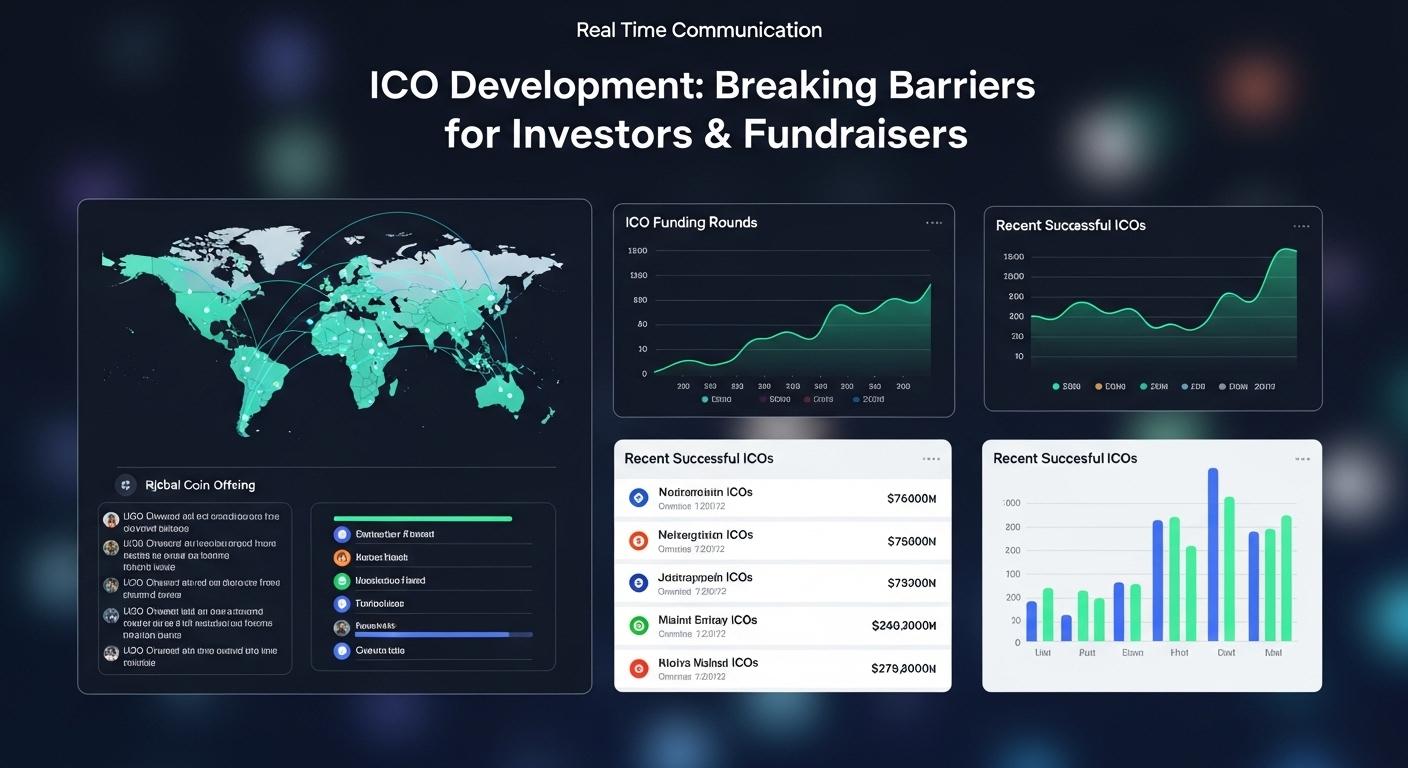
Attention Investors and Fundraisers: The traditional financial landscape has long imposed geographic, regulatory, and accessibility barriers that limit both fundraisers and investors. With the rise of blockchain technology, Initial Coin Offerings (ICOs) are transforming global capital markets. By leveraging ICO development, projects can access international funding, while investors can participate in high-potential ventures regardless of location. This article explores the mechanisms, benefits, trends, risks, and strategies associated with ICO development, highlighting its role in creating borderless opportunities for all stakeholders.
Introduction: The Need for a Borderless Investment Ecosystem
Historically, startups and early-stage ventures relied on local investors, banks, or venture capital firms to secure funding. This model often excludes talented entrepreneurs and investors from regions with limited access to capital. Moreover, traditional fundraising can be slow, bureaucratic, and opaque, leaving investors with limited visibility and fundraisers with constrained options.
ICOs represent a paradigm shift. By issuing digital tokens on a blockchain network, fundraisers can raise capital globally, while investors can access new opportunities with transparency and security.
How ICO Development Removes Barriers
1. Geographic Freedom
ICOs operate on blockchain networks that are inherently global. Fundraisers can reach investors from multiple countries without worrying about local intermediaries or cross-border transaction issues. For investors, this opens up access to promising projects worldwide, leveling the playing field and democratizing investment opportunities.
2. Lowering Entry Barriers
Traditional investment often requires significant capital to participate. ICOs enable fractional investment through tokenized assets, allowing smaller investors to gain exposure to early-stage ventures. This democratization expands the pool of potential investors and empowers individuals who were previously excluded from high-growth opportunities.
3. Transparent Transactions
Blockchain technology ensures that every transaction is recorded immutably. Investors can track fund allocation, token issuance, and project milestones directly on the blockchain. This transparency reduces risks of fraud, mismanagement, and disputes between fundraisers and investors.
4. Speed and Efficiency
ICOs enable rapid capital raising. Unlike conventional fundraising, which may take months or even years, ICO campaigns can secure significant funds in weeks. ICO software development services streamline token issuance, compliance checks, and investor onboarding, making the fundraising process faster and more efficient.
5. Flexible Tokenomics
Tokens issued in ICOs can be designed to provide utility, governance, or revenue-sharing mechanisms. This flexibility allows fundraisers to structure offerings that align investor interests with project success, fostering long-term engagement and loyalty.
Advantages for Fundraisers
Global Investor Access
ICOs eliminate local funding limitations. By tapping into international markets, fundraisers can diversify their investor base, reduce dependence on domestic capital, and increase their potential for higher funding amounts.
Cost-Effective Fundraising
Removing intermediaries such as banks or brokers significantly lowers operational costs. Fundraisers can allocate more funds to product development, marketing, and strategic initiatives.
Engaged Communities
ICOs turn investors into active participants. Through token-based incentives, fundraisers can encourage governance voting, platform advocacy, and user adoption, creating vibrant communities that promote project growth.
Increased Credibility
Partnering with professional ICO development companies ensures robust smart contracts, compliance with KYC/AML regulations, and security audits. A professionally executed ICO builds investor confidence and attracts both retail and institutional participants.
Rapid Market Entry
With faster fundraising, projects can bring products and services to market sooner. This speed can create competitive advantages, establish early market share, and accelerate adoption.
Advantages for Investors
Early-Stage Access
Investors can participate in projects at their inception, potentially gaining significant returns if the venture succeeds. ICOs democratize access to investment opportunities that were previously limited to venture capitalists or accredited investors.
Liquidity Opportunities
Unlike traditional private equity, ICO tokens are often tradable on secondary markets. Investors can buy, sell, or trade tokens, providing flexibility and liquidity that is rarely available in conventional investment instruments.
Transparent Oversight
Blockchain-based ICOs allow investors to monitor every transaction, allocation, and milestone. This level of transparency reduces risk and fosters confidence in the project and the fundraising team.
Portfolio Diversification
ICOs provide exposure to emerging sectors such as decentralized finance (DeFi), blockchain-based gaming, non-fungible tokens (NFTs), and tokenized real-world assets. Diversifying across these assets can reduce risk and create opportunities for higher returns.
Governance and Influence
Governance tokens enable investors to participate in project decision-making. This engagement aligns investor interests with project success and ensures that they have a meaningful voice in strategic development.
Key Trends in ICO Development in 2025
Institutional Participation
Hedge funds, banks, and private equity firms are increasingly entering the ICO space, providing credibility, liquidity, and stability to the market. Institutional involvement encourages further adoption by retail investors.
Hybrid Fundraising Models
Combining ICOs with traditional equity or debt financing allows projects to attract a diverse investor base while mitigating risks. Hybrid models balance conventional investment structures with innovative tokenized offerings.
Integration with DeFi
DeFi features like staking, lending, and liquidity mining are increasingly integrated into ICO ecosystems. These mechanisms enhance token utility, create additional revenue streams for investors, and strengthen long-term engagement.
Tokenization of Real-World Assets
Projects are increasingly tokenizing assets like real estate, art, and commodities. Tokenization allows fractional ownership, enabling investors worldwide to participate in previously inaccessible markets.
ESG-Focused ICOs
Environmental, social, and governance (ESG) considerations are driving investment trends. Socially responsible ICOs attract investors interested in sustainability and impact, broadening the appeal of tokenized projects.
AI-Enhanced Analytics
Investor dashboards powered by AI provide predictive insights, portfolio tracking, and real-time performance monitoring. Fundraisers can optimize campaigns, while investors can make data-driven decisions.
Community-Centric Strategies
Gamification, reward systems, and participatory governance foster investor loyalty, increase adoption, and create a sustainable ecosystem where fundraisers and investors thrive together.
Risks and Considerations
While ICO development breaks barriers and creates opportunities, participants must be aware of potential risks:
-
Regulatory Uncertainty: Legal requirements vary by country, and non-compliance can lead to penalties or halted campaigns.
-
Market Volatility: Token prices may fluctuate dramatically, affecting investor returns.
-
Technical Vulnerabilities: Smart contracts and investor dashboards must be audited to prevent hacking or errors.
-
Execution Risks: Poor management, insufficient demand, or operational challenges can hinder project success.
-
Fraud Risk: Scams exist in the ICO space; professional ICO development services mitigate these through secure and compliant frameworks.
Strategies for Investors and Fundraisers
For Fundraisers:
-
Engage professional ICO development companies to ensure secure, compliant campaigns.
-
Design tokenomics that align incentives with investor expectations.
-
Build active communities with gamification and rewards.
-
Provide transparent reporting and dashboard access.
-
Consider hybrid fundraising models to attract both traditional and crypto-savvy investors.
For Investors:
-
Conduct thorough due diligence on projects, teams, and tokenomics.
-
Understand token utility, governance rights, and revenue-sharing mechanisms.
-
Diversify investments across multiple ICOs and emerging sectors.
-
Use AI-powered dashboards for portfolio insights and decision-making.
-
Participate in governance to influence project direction and protect investment value.
Conclusion
ICO development is transforming the global investment and fundraising landscape by breaking down barriers and creating accessible, transparent, and efficient ecosystems. Fundraisers gain rapid access to global capital, cost efficiency, engaged communities, and increased credibility. Investors benefit from early-stage opportunities, liquidity, portfolio diversification, transparency, and governance participation.
Tokenization is not merely an alternative to traditional funding—it represents a revolutionary model that fosters win-win scenarios, bridging innovation with capital in ways that were previously impossible.

 English
 French
 Spanish
 Portuguese
 Deutsch
 Turkish
 Dutch
Dutch
 Italiano
 Russian
 Romaian
 Portuguese (Brazil)
 Tiếng Việt