


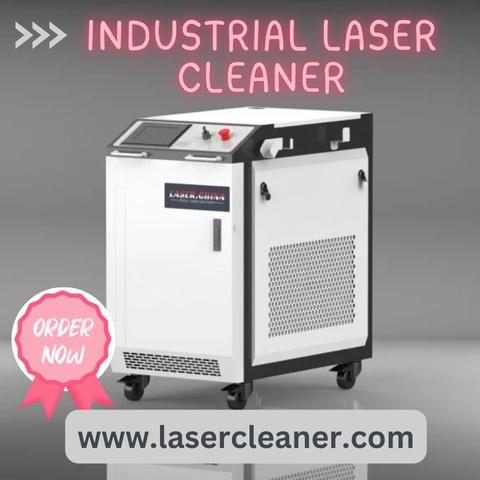
Industrial laser cleaner technology has become one of the most advanced surface preparation solutions in modern manufacturing. Unlike traditional cleaning methods that rely on chemicals, abrasives, or high-pressure systems, the industrial laser cleaner uses controlled laser beams to remove contaminants, oxides, paint, rust, and other unwanted layers from various materials. Its precision and adaptability make it ideal for industries that demand both efficiency and environmental responsibility.
Laser cleaning represents a significant shift in industrial maintenance. It allows manufacturers to achieve a level of cleanliness that was previously difficult to obtain without damaging the substrate. This innovation is now being adopted in sectors such as aerospace, automotive, energy, shipbuilding, and heavy machinery production. The industrial laser cleaner is not only a cleaning tool but also a means to extend the lifespan of equipment and improve operational consistency across industrial facilities.
Understanding the Working Principle of an Industrial Laser Cleaner
The core concept behind an industrial laser cleaner revolves around laser ablation. When the laser beam hits the surface, it delivers a short burst of energy that instantly vaporizes contaminants. This process is highly selective because the laser parameters—such as wavelength, pulse duration, and power—are precisely controlled to remove only the unwanted layer. The underlying material remains untouched and intact.
In practice, laser cleaning systems can operate in both pulsed and continuous modes. Pulsed lasers are typically preferred for delicate applications or thin oxide removal, while continuous lasers are used for larger surface areas and thicker layers. The cleaning process is contact-free and requires no secondary materials like sand or water, making it extremely clean and sustainable.
Sensors and optical feedback systems are often integrated to adjust the cleaning parameters automatically. This ensures consistent performance even when working on complex geometries or irregular surfaces. The result is a repeatable, reliable process suitable for both manual and automated setups.
Industrial Applications and Usage Scenarios
The industrial laser cleaner is now used across a broad range of industries. In the automotive sector, it plays a key role in removing paint, rust, and oil from parts before welding or coating. Clean surfaces lead to stronger joints and better-quality finishes. Manufacturers also use it to restore molds, dies, and tools, helping reduce downtime and maintenance costs.
In the aerospace industry, laser cleaning ensures that aircraft components remain free from oxides and residues that could affect performance or safety. Because laser cleaning does not involve chemicals, it avoids the risk of contamination, which is critical for aerospace materials like titanium and aluminum.
The energy and power generation sector uses industrial laser cleaners to remove corrosion and residues from turbine blades, pipelines, and reactor components. These applications demand absolute precision and reliability, which laser cleaning provides consistently.
In shipbuilding and marine maintenance, lasers are replacing abrasive blasting methods for removing paint and rust from metal hulls and decks. The portability of modern systems allows workers to carry out on-site cleaning with minimal disruption.
The electronic and semiconductor industry also benefits from the precision of laser cleaning. It removes micro-level contaminants without affecting sensitive surfaces, ensuring the high purity levels required for microchip and circuit board production.
Efficiency in Industrial Environments
Industrial laser cleaning technology is designed for productivity. It reduces manual labor, minimizes downtime, and allows for integration with robotic systems. Automation is particularly beneficial for repetitive cleaning tasks, where robots equipped with laser cleaning heads can perform operations continuously with uniform results.
The equipment’s control software enables operators to adjust parameters like beam intensity, scan speed, and focal length, depending on the type of material being treated. For example, cleaning aluminum surfaces requires lower laser power compared to steel. Such adaptability enhances efficiency across diverse applications.
The dry and contact-free process also eliminates the need for post-cleaning steps like rinsing, drying, or chemical disposal. This simplifies workflow and supports lean manufacturing practices. In addition, laser cleaning reduces wear and tear on machinery by keeping surfaces free of contaminants that could cause friction or corrosion during operation.
Surface Quality and Precision
An industrial laser cleaner delivers surface finishes that meet exacting industrial standards. The process can achieve micrometer-level precision, allowing operators to target only the contaminated areas. This is especially important when cleaning components with tight tolerances or complex geometries.
The laser’s energy can be finely tuned to achieve the desired level of cleanliness, from light oxide removal to full-scale rust stripping. Because there is no physical contact, even delicate surfaces can be treated without mechanical stress. The result is a uniformly clean substrate ready for subsequent processes like welding, coating, or bonding.
In industrial production lines, this level of control improves process repeatability. It ensures that each part meets quality specifications, reducing rework and inspection times. For industries that demand consistent results at scale, such as automotive manufacturing, this precision is a key factor in maintaining production efficiency.
Environmental and Operational Impact
The industrial laser cleaner aligns with modern sustainability goals. Traditional cleaning methods often involve chemicals, solvents, or blasting media that generate hazardous waste. In contrast, laser cleaning produces minimal residue—mostly microscopic dust that can be easily collected using standard ventilation systems.
This not only reduces the environmental footprint but also creates a safer workplace. Operators are not exposed to harmful substances or abrasive dust. The system requires minimal consumables, which significantly lowers operational costs and simplifies logistics.
Energy consumption is another area of improvement. Despite using high-powered lasers, these systems are designed for energy efficiency. Their focused output ensures that energy is used precisely where it is needed, without unnecessary waste.
For companies pursuing green manufacturing certifications or compliance with environmental regulations, adopting industrial laser cleaning technology supports both operational performance and sustainability commitments.
Maintenance and Durability of the Equipment
Like any industrial machinery, an industrial laser cleaner requires regular maintenance to sustain performance. The laser source, optics, and cooling systems should be inspected periodically. Dust filters and ventilation systems also need cleaning to prevent buildup.
Manufacturers typically provide diagnostic tools and software that monitor system performance. Any deviations in laser power, beam alignment, or optical clarity can be detected early. Preventive maintenance not only extends the lifespan of the equipment but also ensures continuous, reliable operation in demanding environments.
The robust design of industrial laser cleaners allows them to function in harsh industrial settings, including factories, shipyards, and outdoor construction sites. Portable and enclosed units are available to suit different operational needs.
Technological Integration and Automation Potential
Modern production systems emphasize automation and data integration. Industrial laser cleaners can easily be incorporated into existing automated lines through robotic arms, CNC platforms, or conveyor-based setups.
Using programmable logic controllers (PLCs) and industrial communication protocols, laser cleaning units can synchronize with other equipment to perform cleaning cycles as part of a broader process chain. For instance, in a welding line, components can be automatically cleaned by the laser before welding begins—ensuring optimal surface conditions without manual intervention.
Data logging and system analytics further enhance process control. Operators can track cleaning parameters, surface temperature, and laser performance, creating a record that supports quality assurance and traceability.
Industrial Impact and Future Outlook
The adoption of industrial laser cleaners is reshaping how industries approach maintenance, repair, and production preparation. As technology advances, laser cleaning systems are becoming more compact, energy-efficient, and accessible to small and medium-sized enterprises.
In the near future, we can expect broader integration of AI-driven controls, advanced optics, and adaptive automation in laser cleaning technology. These improvements will further enhance precision, reduce operating costs, and make the process even more adaptable across diverse materials and industries.
Laser cleaning is now seen not merely as a cleaning solution but as a part of a larger industrial transformation toward smart, sustainable, and high-efficiency manufacturing systems.
Final Thoughts
The industrial laser cleaner stands as a reliable and forward-looking solution for modern industries seeking safe, efficient, and sustainable surface preparation methods. It offers unmatched precision, cleanliness, and operational consistency across a wide range of materials and applications.
Its growing role in global manufacturing reflects the broader trend toward cleaner, smarter technologies that enhance productivity while minimizing environmental impact. As more industries recognize the advantages of this method, the industrial laser cleaner will continue to redefine surface treatment standards and drive the next phase of industrial innovation.

 English
 Arabic
 French
 Spanish
 Portuguese
 Deutsch
 Turkish
 Italiano
 Russian
 Romaian
 Portuguese (Brazil)
 Tiếng Việt