


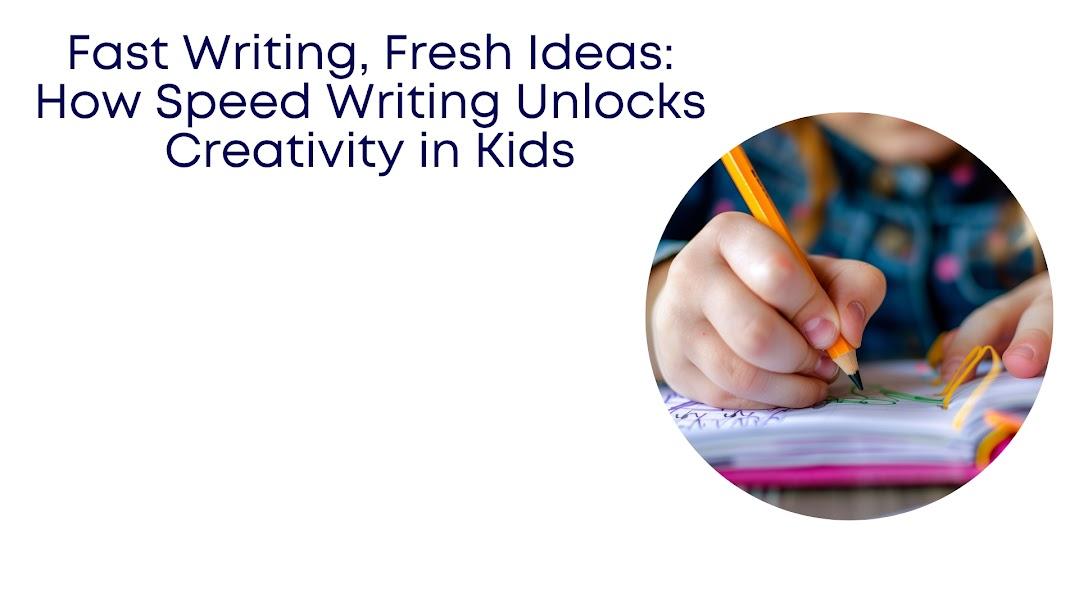
In a world filled with constant notifications, tight deadlines, and endless distractions, creativity can often feel out of reach. Many young writers sit in front of a blank page, waiting for that “aha” moment — but what if creativity isn’t something you wait for, but something you create through action?
That’s where speed writing courses for kids come in — a simple yet powerful technique that helps children break creative blocks, think freely, and discover new ideas faster than ever before.
What Exactly Is Speed Writing?
Speed writing is the practice of writing continuously for a specific period without stopping to edit, analyze, or second-guess yourself. The purpose isn’t to write perfectly — it’s to write freely.
When you let your thoughts flow without interruption, you tap into the intuitive part of your brain — the one responsible for imagination and creativity — while quieting the inner critic that often holds you back.
Think of it as brainstorming in motion. Instead of organizing thoughts into tidy outlines or lists, you pour them directly onto paper. The goal is momentum — keeping your ideas flowing and your creativity alive.
Why Speed Writing Boosts Creativity
Most creative blocks come from overthinking. We worry about grammar, sentence structure, or whether an idea is “good enough.” Speed writing removes those barriers by focusing on progress rather than perfection.
By simply writing without pause, you:
-
Conquer the fear of the blank page
-
Spark fresh and surprising ideas
-
Discover new perspectives and connections
-
Strengthen your natural writing voice
-
Build creative confidence through daily practice
Speed writing helps you rediscover the fun of writing — unfiltered, fearless, and full of discovery.
Speed Writing as a Brainstorming Tool
Traditional brainstorming can feel rigid — a list of ideas that may or may not connect. Speed writing transforms that into an organic, imaginative process.
When your thoughts are allowed to flow freely, they connect in unexpected ways. For instance, you might start writing about recycling and end up describing a city powered by clean energy. These spontaneous jumps often lead to original stories, projects, or essay ideas that structured thinking might miss.
The Power of Writing Without Judgment
One of the biggest enemies of creativity is self-criticism. Thoughts like “This doesn’t sound right” or “No one will like this idea” can stop creativity in its tracks.
Speed writing permits you to write badly — and that’s exactly what frees you to write brilliantly later. When you remove judgment, your imagination opens up. The first draft becomes a playground, not a test.
Remember, speed writing isn’t about producing polished work; it’s about generating raw material. The editing and refining come later — once the creative energy has done its job.
Simple Speed Writing Techniques to Try
If you’re just getting started, here are a few easy exercises you can use:
-
Timed Writing: Set a timer for 10–15 minutes. Pick a topic and write nonstop until the timer ends. No editing allowed!
-
Stream of Consciousness: Write down whatever comes to mind — random thoughts, images, memories — and let them lead you.
-
Prompt Writing: Use creative prompts like “Describe rain without using the word wet.” Write fast and see what happens.
-
Morning Pages: Write three full pages first thing in the morning to clear mental clutter and spark ideas.
-
Word Association: Start with one word and let it lead you. For example, “sun” might lead to “energy,” then “growth,” then “hope.”
Why Pen and Paper Still Matter
While typing is faster, many writers find that handwriting encourages deeper thinking. Using a notebook helps kids disconnect from screens and focus fully on the flow of words.
Writing by hand slows you down just enough to think clearly, yet still keeps ideas moving freely. Plus, a notebook feels personal — a safe space where imagination has no limits.
Tips to Maximize Your Speed Writing Sessions
-
Keep going — even if it feels messy. The best ideas often come after a rough start.
-
Ignore mistakes. Spelling, grammar, and punctuation don’t matter right now.
-
Write every day. Just 10 minutes can build lasting creative habits.
-
Create your vibe. Play music, sit by a window, or find your quiet zone.
-
Review later. Let your words rest, then return to highlight the gems.
Note:- Take the BeyondTechings Franchise and start your own Handwriting classes now.
Conclusion
Speed writing isn’t about speed — it’s about freedom. It’s about letting go of judgment, embracing imperfection, and allowing ideas to flow naturally.
The next time your child (or you!) feels stuck, grab a pen, set a timer, and just write. You’ll be amazed at the original ideas that emerge when you stop thinking and start creating.

 English
 Arabic
 French
 Spanish
 Portuguese
 Deutsch
 Dutch
Dutch
 Italiano
 Russian
 Romaian
 Portuguese (Brazil)
 Tiếng Việt